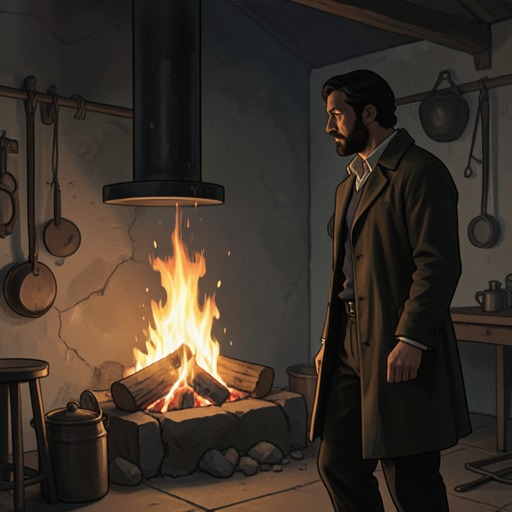
Pip's apprenticeship to Joe Gargery
Great ExpectationsPip's apprenticeship to Joe Gargery is both a formal binding to the blacksmith's trade and a turning point in Pip's sense of himself. What he had once imagined as a happy path to manhood becomes, after his encounter with Estella and Miss Havisham, an emblem of the common life he has learned to despise. The event's deepest consequence is not the indenture itself, but the shame and self-alienation that Pip carries into it.
The Binding and Its Public Spectacle
After receiving money from Mr. Pumblechook, Pip's sister agrees that he must be bound apprentice to Joe. Pumblechook says he will see to the arrangement, and the group goes to the Town Hall, where the Justices sit. Pip recalls being pushed through the crowd by Pumblechook as though he had been caught committing a crime. Onlookers mistake the proceeding for an arrest; one gives Pip a tract depicting a young man fettered and headed for a cell.
Inside, the Hall seems to Pip like a strange parody of a church, with high pews, spectators leaning over them, and Justices variously reclining, taking snuff, dozing, writing, or reading newspapers. In a corner, his indentures are signed and attested, and he is formally bound to Joe. Pumblechook holds him throughout as if they had stopped on the way to the scaffold. The legal formality is thus remembered through the child's humiliating sense of public judgment, even though the occasion is an apprenticeship rather than a punishment.
Celebration and Disappointment
The binding is followed by a dinner at the Blue Boar, paid for from the twenty-five guineas. Pip's sister insists on the outing, and Pumblechook invites the Hubbles and Mr. Wopsle. Pip, however, feels like an unwelcome presence at a celebration supposedly held for him. The company repeatedly asks why he is not enjoying himself, obliging him to claim that he is when he is not.
Pumblechook takes the place of honor and turns Pip's indentures into a public lesson, congratulating the company on the restrictions and possible imprisonment the document appears to threaten if Pip gambles, drinks, keeps late hours, or falls into bad company. Pip is made to stand on a chair beside him as an illustration. The evening continues past Pip's weariness: whenever he begins to fall asleep, the adults wake him and tell him to enjoy himself. Mr. Wopsle recites Collins's ode with such force that a waiter comes to complain on behalf of the Commercials below. The party's high spirits only sharpen Pip's isolation; by the time he reaches his bedroom, he is wretched and convinced that he will never like Joe's trade.
From Home to Shame
That conviction marks a reversal. Pip had once expected to roll up his sleeves and enter the forge as Joe's apprentice, distinguished and happy. Now the reality feels like coal dust on him, while the daily prospect of the trade weighs more heavily than the anvil. He remembers the forge as the road to manhood and independence, and the kitchen and front room as places invested with dignity. Within a year, after visiting Miss Havisham and meeting Estella, those same surroundings have come to seem coarse and common. He does not want Estella or Miss Havisham to see them.
The change also alters Pip's understanding of Joe. Lying awake after his first visit to Miss Havisham, Pip had already imagined how Estella would judge Joe's thick boots and coarse hands, and contrasted the kitchen with the world of Miss Havisham and Estella. By the time his apprenticeship begins, the forge is no longer the future he once welcomed. Pip later describes the moment as one of the memorable days that formed a link in the chain of his life: a single encounter has redirected his sense of home, work, and aspiration.
Retrospective Judgment and Consequences
The adult narrator refuses to assign the change to one cause alone. He acknowledges that his own disposition, Miss Havisham's influence, and his sister's influence may all have contributed, but insists that the alteration in him was accomplished. His retrospective account preserves both the boy's distress and the older Pip's awareness that the shame was not a neutral discovery about the forge; it was a transformation in how he chose to value it.
Though deeply dejected on the first working day, Pip says he never complained to Joe during the term of his indentures. That restraint does not undo the inward distance. Later, when Pip receives expectations and plans to leave, he grows gloomy as Joe and Biddy discuss what they will do without him, and interprets their affectionate looks as mistrust, although they have given him no reason to think so. Much later still, when his expectations collapse, Joe's tactful care and Biddy's kindness make Pip understand what he had forfeited through his earlier conduct. The apprenticeship therefore remains a hinge in his story: it binds him to Joe in law, while his changing ideas of gentility begin to estrange him from the very home that had once promised independence.